Back
Try for freeOpen Product
 MetalTox
 MetalTox
MetalTox (HeavyMetalDx) is an interactive heavy-metal toxicity reference that maps symptoms to metals, recommends the appropriate test matrix (blood vs urine, etc.), and supports severity grading with cutoffs using a structured, clinician-friendly workflow.

Overview
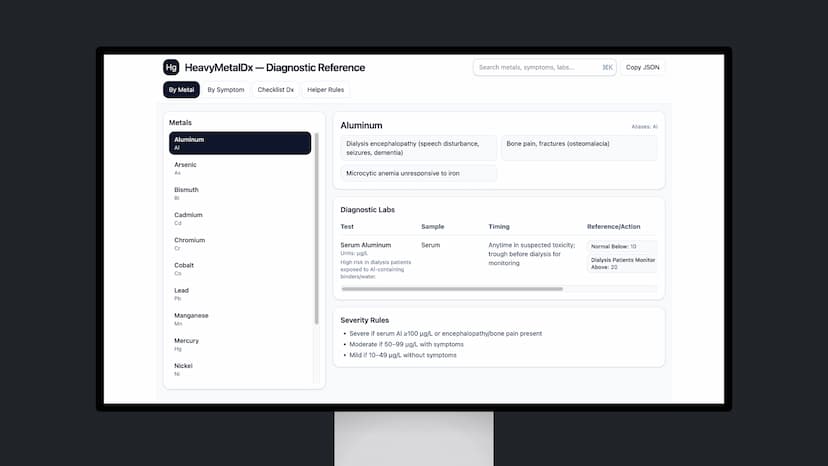
Browse metals (with aliases) and see key clinical associations, diagnostic lab options, and reference/action cutoffs in one place.
Provides test details (sample type, timing notes) and severity rules/cutoffs to help grade toxicity and guide interpretation.
Start from a symptom (e.g., alopecia, neuropathy, skin findings) and jump directly to likely metals and the relevant diagnostic panel.
Select lab thresholds and clinical signs to generate a ranked differential with probability estimates and evidence mapping.
Includes quick rules for preferred specimen choice (e.g., venous whole blood vs urine, speciation) and common timing pitfalls (e.g., seafood arsenic interference, acute vs chronic windows).
Search across metals, symptoms, and labs, and export/copy the underlying structured data (JSON) for reuse.
Version history
• Initial release of the product
Questions
MetalTox is designed for poison center specialists, medical toxicologists, emergency clinicians, ICU teams, hospitalists, occupational medicine providers, trainees, and pharmacists evaluating suspected heavy-metal exposure or unexplained compatible syndromes.
You can start with either (1) clinical findings (symptoms/signs), (2) a suspected metal, or (3) a lab result/threshold. The tool is most useful when you also know exposure context (acute vs chronic, occupational vs ingestion) and timing relative to testing.
Yes. The Helper Rules/Matrix Matching section is built specifically to reduce wrong-matrix ordering (blood vs urine, speciation, etc.) and includes timing caveats that commonly mislead interpretation.
No. It supports structured differential generation and test selection. Final diagnosis still depends on clinical judgment, exposure history, confirmatory testing, and ruling out non-metal mimics.
Yes, the tool explicitly includes timing caveats and matrix rules that differ by exposure type, but results always need to be interpreted in context of timing, baseline risk, and the specific lab's reference method.
Use caution. The checklist differential can still help prioritize, but mixed exposures and non-toxicologic disease processes can create overlapping patterns. Treat outputs as "ranking support," not a final answer.
Legal
We respect your privacy; this section explains what information we collect, how we use it, and how we protect its security.
Read Privacy PolicyLegal
This section outlines the rules, obligations, and rights that apply when you use our website or services.
Read Terms and Conditions