Christa Pike Survives Tennessee Pentobarbital Execution Attempt: Toxicology Questions Remain
post on 02 Oct 2026

post on 02 Oct 2026
 Medical Toxicologymedicaltoxic.com
https://medicaltoxic.com/news/christa-pike-pentobarbital-execution-attempt
Christa Pike Survives Tennessee Pentobarbital Execution Attempt: Toxicology Questions Remain
Tennessee says its lethal-injection protocol was followed, yet Christa Pike survived an initial and backup pentobarbital dose. The key toxicology question is how much drug actually reached systemic circulation.
Christa Pike remained alive after Tennessee attempted to execute her with pentobarbital on September 30, creating an unusual pharmacologic question that cannot be answered simply by citing the amount of drug prepared for injection.
The Tennessee Department of Correction said it followed the state's established lethal-injection protocol and that no further procedure was authorized after the steps carried out that evening. Pike was then transported to an off-site medical facility. [1]
Media witnesses and her attorneys reported that both the initial and backup pentobarbital rounds were administered, yet Pike continued breathing and remained alive. By the following day, her attorneys said she was in critical condition and receiving lifesaving hospital care. [2]
The event has prompted Tennessee Governor Bill Lee to halt the state's remaining scheduled execution for 2026 and order a comprehensive third-party review. [2]
From a medical-toxicology perspective, however, the most important unanswered question is narrower:
How much pharmacologically active pentobarbital actually entered Pike's systemic circulation—and over what period of time?
Tennessee moved to a single-drug pentobarbital execution protocol after completing a protocol review in late 2024.
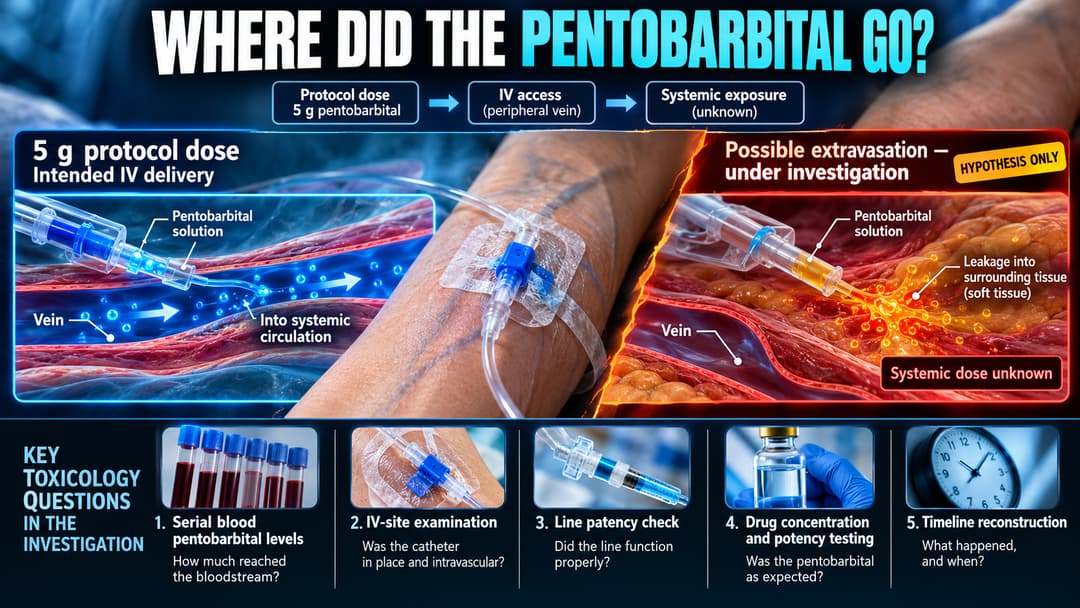
The current protocol calls for a 100-mL pentobarbital solution at 50 mg/mL, corresponding to 5 g of pentobarbital, with a backup set available if the person is not deceased after the first administration. [3]
Reporting from the execution indicates that both the initial and backup rounds were used. [2]
That does not, however, establish that 10 g of pentobarbital successfully entered the central circulation.
There is an important pharmacologic distinction between:
dose prepared → dose pushed through the line → dose actually delivered intravascularly → systemically absorbed dose
Those quantities are not necessarily identical.
Pentobarbital is a short-acting barbiturate and a potent central nervous system depressant.
With intravenous administration, onset can occur almost immediately. Barbiturates produce dose-dependent respiratory depression, and severe poisoning can progress to coma, hypotension, apnea, circulatory collapse and death. [4]
The labeled therapeutic IV doses are measured in hundreds of milligrams rather than grams.
A reported protocol dose of 5 g is therefore far outside ordinary therapeutic administration.
But dose on paper is not equivalent to systemic exposure.
That distinction is central to interpreting Pike's survival.
Witnesses and attorneys described prolonged difficulty establishing IV access.
One of Pike's attorneys said he observed at least seven needle placements in one arm. Pike also complained of significant arm discomfort during the procedure. [2]
Her lawyers later reported discoloration and blistering around injection areas and suggested that some of the drug may have entered soft tissue rather than the bloodstream. Those observations have not yet been independently confirmed by a publicly released medical examination. [5]
That hypothesis is pharmacologically plausible—but still unproven.
Pentobarbital injection is highly alkaline. The current U.S. prescribing information places the solution at approximately pH 9.5 and specifically warns against perivascular extravasation.
The label states that extravascular injection can cause local tissue injury and subsequent necrosis and that limb pain during administration warrants stopping the injection. [4]
Therefore, reports of severe arm pain and local tissue changes are compatible with possible extravasation.
They are not proof that extravasation occurred, nor do they quantify how much pentobarbital may have entered tissue versus circulation.
This is the key toxicology principle in the case.
If a syringe contains 5 g of pentobarbital, three different quantities still matter:
The amount prepared
This is determined by drug concentration and volume.
The amount delivered through the IV apparatus
This depends on the line, connections, patency and whether leakage occurred.
The amount reaching systemic circulation
This is the pharmacologically relevant exposure.
If a substantial portion of an intended IV dose entered surrounding tissue instead, systemic delivery could be delayed, incomplete or markedly different from what the protocol dose alone would suggest.
The same principle applies to a backup dose.
Saying that two 5-g sets were prepared or administered does not establish that a full 10 g reached circulating blood.
Intravenous pentobarbital reaches the central nervous system rapidly.
Extravascular administration changes the pharmacokinetic problem.
Instead of an immediate intravascular bolus, drug deposited in tissue must be absorbed from that compartment before reaching systemic circulation.
Absorption may be slower, variable or incomplete, while the alkaline solution itself can injure local tissue.
That creates two potentially simultaneous problems:
less predictable systemic pentobarbital delivery
and
greater local tissue injury.
The available public evidence does not yet establish whether this occurred in Pike's case.
Incomplete IV delivery is not the only possible explanation.
A rigorous investigation should also examine:
the verified concentration and potency of the pentobarbital used;
preparation and storage conditions;
the integrity and patency of each IV line;
whether leakage or infiltration occurred during either administration;
the exact timing and rate of both pentobarbital administrations;
saline flushing and line-confirmation procedures;
physiologic monitoring during the procedure;
the timing of subsequent medical intervention; and
any relevant individual pharmacokinetic or physiologic factors.
At present, publicly available information does not establish which factor—or combination of factors—caused the failed execution.
The Tennessee Department of Correction maintains that its established protocol was followed. [1]
Governor Lee's independent review is intended to determine what occurred. [2]
Several pieces of evidence could substantially improve reconstruction of the event.
Blood pentobarbital measurements obtained soon after the attempted execution and followed over time could help establish the magnitude and kinetics of systemic exposure.
A concentration cannot perfectly reconstruct the administered dose by itself, particularly if sampling occurred late or distribution was ongoing.
But serial concentrations would be far more informative than protocol dose alone.
Documentation of swelling, discoloration, blistering, tissue injury or other findings at each attempted access site could help evaluate whether infiltration or extravasation occurred.
The investigation should determine how line patency was assessed before, during and after each administration and whether resistance, swelling or loss of flow was recorded.
Testing retained drug or preparation samples, when available, could establish whether the expected concentration and potency were present.
The timing of consciousness changes, respiratory depression, blood pressure abnormalities, neurologic findings, ventilation, resuscitative treatment and subsequent recovery would help characterize the actual barbiturate exposure.
None of these data have yet been released in sufficient detail to establish a definitive toxicologic explanation.
One interpretation should specifically be avoided.
Pike's survival should not immediately be described as evidence of extraordinary physiologic resistance or tolerance to pentobarbital.
Without knowing the amount and rate of systemic drug delivery, that conclusion would be premature.
Pentobarbital's pharmacology is well established: sufficiently high systemic concentrations produce profound CNS and respiratory depression. [4]
The failed outcome therefore requires examination of exposure, delivery and pharmacokinetics before unusual biologic resistance is invoked.
Pike reportedly complained of arm pain while the procedure was underway.
Her lawyers subsequently described discoloration and blistering and argued that pentobarbital may have entered tissue rather than the vein. [2] [5]
That observation deserves toxicologic attention because it aligns with the known hazards of extravascular pentobarbital.
But it remains an investigative hypothesis.
Neither blood pentobarbital levels, independent IV-site findings nor detailed line records have been publicly released.
The Pike case also follows another incomplete Tennessee execution earlier in 2026.
In that case, officials were unable to establish suitable intravenous access and the execution was stopped before pentobarbital was administered. [2]
Pike's case is pharmacologically different because pentobarbital administration was reported to have proceeded.
That makes determining where the drug actually went especially important.
The case illustrates a basic but often overlooked principle in clinical toxicology:
The dose prepared, the dose administered and the dose that reaches systemic circulation are not necessarily the same dose.
Route, vascular access, line function, absorption, formulation and timing can fundamentally change exposure.
If Tennessee's initial and backup 5-g pentobarbital sets were both used as reported, the investigation should not begin by assuming that the entire nominal amount immediately reached circulating blood.
It should determine whether it did.
This is not simply another report of difficult IV access.
Tennessee says its single-drug protocol was carried through to the point at which no additional procedure was authorized, and witnesses reported both an initial and backup pentobarbital administration. Yet Pike remained alive and required hospital treatment. [1] [2]
That shifts the central toxicology question from:
Was the lethal drug prepared?
to:
How much active pentobarbital actually reached systemic circulation, and how quickly?
Christa Pike's survival after Tennessee's September 30 pentobarbital execution attempt cannot yet be explained from the publicly available evidence.
The state's protocol calls for a 5-g pentobarbital dose with a backup set if necessary, and both rounds were reportedly administered.
But protocol dose is not the same as systemic exposure.
Reports of difficult vascular access, arm pain and local tissue changes make incomplete or abnormal intravascular delivery an important hypothesis. Pentobarbital's own prescribing information confirms that extravascular exposure can cause substantial tissue injury. [4]
Other explanations—including drug concentration, preparation, storage, line integrity, timing and subsequent medical intervention—also remain unresolved.
Until blood drug concentrations, IV-site findings, line records and other pharmacologic data are available, attributing the outcome to any single cause would go beyond the evidence.
The most useful toxicology question is therefore not simply whether pentobarbital can be lethal.
It is:
Where did the pentobarbital actually go?
Tennessee Department of Correction. (2026, September 30). Media Advisory: Christa Pike #261368.
Chandler, K., & Hall, K. M. (2026, October 1). Christa Pike is in critical condition after Tennessee’s failed execution attempt, her lawyers say. Associated Press.
Tennessee Department of Correction. (2025). Tennessee Department of Correction Lethal Injection Execution Protocol.
National Library of Medicine. (2026). Pentobarbital Sodium Injection, USP — Prescribing Information. DailyMed.
Allen, J. (2026, October 1). Christa Pike getting ‘life-saving medical care’ after surviving Tennessee execution. Reuters.
Keep reading
Global Toxicology News
27 Jun 2026

Global Toxicology News
08 Jan 2026

Global Toxicology News
01 Jan 2026

Global Toxicology News
23 Oct 2025