Methotrexate Toxicity: Clinical Guideline
Published on 26 Sept 2026 · Updated 02 Oct 2026

Published on 26 Sept 2026 · Updated 02 Oct 2026
 Medical Toxicologymedicaltoxic.com
https://medicaltoxic.com/guidelines/comprehensive-guide-to-methotrexate-toxicity-symptoms-preven
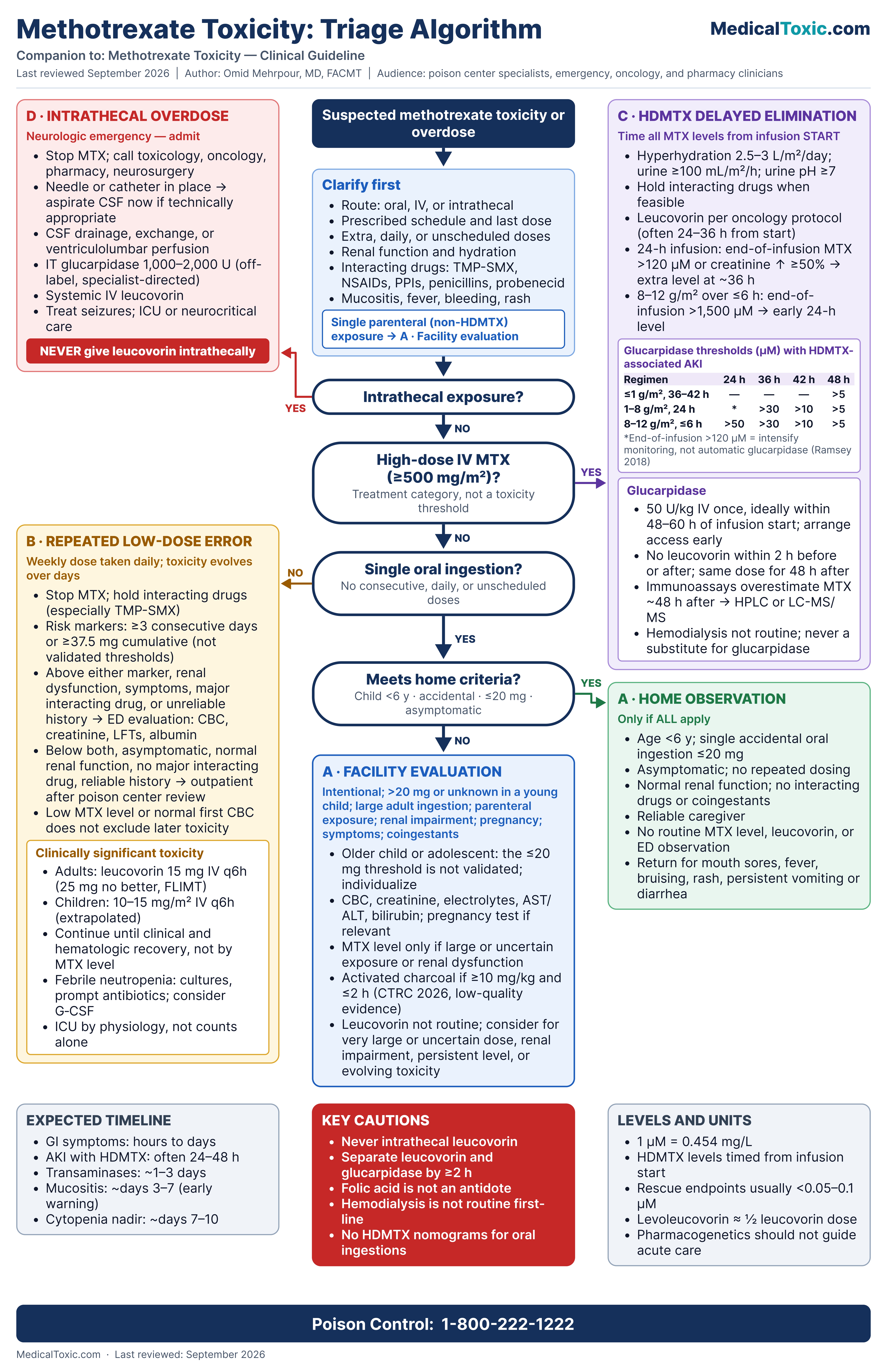
Acute oral ingestion, repeated low-dose therapeutic errors, high-dose methotrexate delayed elimination, and intrathecal overdose
Methotrexate (MTX) toxicity cannot be managed with a single dose threshold or universal algorithm. Risk, laboratory interpretation, rescue therapy, and disposition depend primarily on the exposure pattern, route, renal function, duration of exposure, and, during HDMTX therapy, concentration-time kinetics.
Classify every case into one of four pathways before choosing tests or treatment.
Pathway | Typical scenario | Main risk | MTX concentrations | Core management |
|---|---|---|---|---|
A. Single acute oral ingestion | Child finds tablets; single intentional adult ingestion | Usually low after modest oral doses | Usually limited value; consider for large/uncertain exposures or renal dysfunction | Supportive care; selective activated charcoal; leucovorin only for higher-risk cases |
B. Repeated low-dose therapeutic error | Weekly MTX taken daily or too frequently | Delayed mucositis, cytopenias, sepsis, AKI | Limited prognostic value; a low level does not exclude toxicity | Stop MTX, CBC/renal monitoring, leucovorin for clinically significant toxicity, aggressive infection management |
C. HDMTX delayed elimination | ≥500 mg/m² IV with AKI or delayed clearance | Time-dependent systemic toxicity | Essential and interpreted from infusion start | Hyperhydration, urine alkalinization, pharmacokinetically guided leucovorin, glucarpidase when indicated |
D. Intrathecal overdose | Excess dose/concentration given intrathecally | Severe neurotoxicity | Plasma and CSF concentrations may assist specialist management | Immediate CSF removal/exchange, IV leucovorin, specialist-directed intrathecal glucarpidase |
Clinical warning
Methotrexate toxicity must be managed according to the exposure pathway rather than by applying one universal dose, concentration, or observation rule.
≥500 mg/m² defines high-dose methotrexate (HDMTX); it is a treatment category, not a toxicity threshold.
A low or undetectable serum MTX concentration does not exclude severe repeated low-dose toxicity.
Repeated low-dose toxicity may evolve over several days; initially normal blood counts do not exclude later cytopenias.
Never administer leucovorin intrathecally. Fatal neurotoxicity has been reported.
Separate leucovorin and glucarpidase by at least 2 hours before and after glucarpidase.
Hemodialysis is not a routine substitute for glucarpidase in HDMTX delayed elimination.
Intrathecal MTX overdose is a neurologic emergency requiring immediate specialist management.
Usually low risk after modest oral doses.
MTX concentration has limited value except after a large or uncertain exposure or with renal dysfunction.
In an asymptomatic child younger than 6 years with a reliable single accidental ingestion ≤20 mg, normal renal function, and a reliable caregiver, home observation is reasonable.
Refer/evaluate young children after >20 mg or an unknown amount, intentional ingestion, possible repeated dosing, renal impairment, symptoms, or significant coingestants.
Consider single-dose activated charcoal after approximately ≥10 mg/kg when presentation is within 2 hours and the airway is protected.
Leucovorin is not routine after a small uncomplicated single ingestion.
Delayed mucositis, cytopenias, sepsis, AKI, and skin toxicity are major concerns.
A low or undetectable MTX concentration does not exclude toxicity.
≥3 consecutive dosing days or cumulative ≥37.5 mg are observational risk markers, not validated antidote, admission, or discharge thresholds.
Above either marker, ED assessment with CBC and renal function testing is reasonable.
Empiric leucovorin is case-specific, particularly when renal dysfunction, interacting medications, uncertain exposure, symptoms, or evolving laboratory abnormalities are present.
For clinically significant toxicity in adults, leucovorin 15 mg IV every 6 hours is a reasonable standard rescue regimen.
Treat neutropenic infection and sepsis aggressively.
≥500 mg/m² IV defines the HDMTX treatment category, not toxicity.
Hyperhydration: approximately 2.5–3 L/m²/day.
Urine output target: approximately ≥100 mL/m²/h.
Maintain urine pH ≥7.
Timed MTX concentrations are interpreted from the start of infusion.
Leucovorin commonly begins 24–36 hours after infusion start according to the oncology protocol.
Arrange glucarpidase access early when delayed elimination or AKI suggests it may become necessary.
Stop MTX immediately.
If the needle or catheter remains in place, aspirate CSF immediately when technically appropriate.
Remove CSF MTX through repeated drainage, exchange, or ventriculolumbar perfusion according to dose, timing, severity, and expertise.
Intrathecal glucarpidase 1,000–2,000 units has been reported in severe overdose but remains off-label and case-based.
Administer systemic IV leucovorin.
Never administer leucovorin intrathecally.
HDMTX regimen | 24 h | 36 h | 42 h | 48 h |
|---|---|---|---|---|
≤1 g/m² over 36–42 h | — | — | — | >5 µM |
1–8 g/m² over 24 h | EOI >120 µM = intensified monitoring | >30 µM | >10 µM | >5 µM |
8–12 g/m² over ≤6 h | >50 µM | >30 µM | >10 µM | >5 µM |
Ramsey thresholds are applied with HDMTX-associated AKI or creatinine elevated relative to baseline; the European consensus is somewhat broader. [8] [10]
Glucarpidase: 50 U/kg IV once over approximately 5 minutes; give as early as possible, ideally within 48–60 hours from infusion start.
Leucovorin around glucarpidase: none within 2 hours before or after; continue the same dose for the first 48 hours after glucarpidase, then adjust according to MTX concentration; continue until below the applicable rescue threshold for at least 3 days. [11]
Assay: conventional immunoassays may overestimate active MTX for approximately 48 hours after glucarpidase because of DAMPA; use HPLC or LC-MS/MS when available.
ECTR: EXTRIP advises against routine extracorporeal treatment and against substituting it for glucarpidase. [13]
Units: 1 µM = 0.454 mg/L = 0.454 µg/mL.
≥500 mg/m² defines high-dose methotrexate (HDMTX). It is a treatment category, not a toxicity threshold.
A single acute oral ingestion is fundamentally different from repeated daily dosing.
Repeated low-dose toxicity may evolve over several days. Being well several hours after a repeated exposure does not exclude later toxicity.
Mucositis may be an early warning sign of systemic toxicity and subsequent marrow suppression.
Serum MTX concentrations are essential for HDMTX delayed elimination but may be low or undetectable during severe repeated low-dose toxicity.
Severe low-dose toxicity often becomes life-threatening because of neutropenic infection and sepsis.
Never administer leucovorin intrathecally.
Separate leucovorin and glucarpidase by at least 2 hours.
Hemodialysis is not routine first-line MTX elimination therapy when standard rescue measures are available.
MTX is a folate antagonist. It inhibits dihydrofolate reductase, reducing intracellular tetrahydrofolate availability and impairing thymidylate and purine synthesis. Rapidly proliferating tissues, particularly bone marrow and gastrointestinal/oral mucosa, are therefore susceptible to toxicity.
At lower anti-inflammatory doses, inhibition of AICAR transformylase with increased extracellular adenosine contributes importantly to therapeutic effects.
Parameter | Clinical relevance |
|---|---|
Oral absorption | Carrier-mediated and saturable. Mean oral bioavailability is approximately 60% at doses ≤30 mg/m² and decreases as dose increases. This contributes to the relatively limited toxicity of many single acute oral overdoses. [1] |
Protein binding | Approximately 50%. |
Distribution | Approximate volume of distribution 0.4–0.8 L/kg. MTX may accumulate in pleural effusions and ascites, prolonging elimination. |
Intracellular retention | MTX is converted to polyglutamates that remain intracellularly after plasma MTX falls and contribute to prolonged biologic effects. |
Elimination | Predominantly renal, through glomerular filtration and active tubular secretion; most systemic MTX is excreted unchanged. |
Metabolism | Minor conversion to 7-hydroxymethotrexate. MTX is not primarily cleared through CYP450 metabolism. |
Solubility | MTX and 7-hydroxymethotrexate are poorly soluble in acidic urine. Solubility increases substantially as urine pH rises. |
Drug/class | Mechanism or concern | Practical significance |
|---|---|---|
Trimethoprim-sulfamethoxazole | Additive antifolate effect plus reduced renal MTX handling | Particularly concerning during low-dose MTX therapy |
NSAIDs, including aspirin | Reduced renal perfusion and impaired tubular clearance | Greater concern with renal dysfunction or HDMTX |
Penicillins, including piperacillin | Competition for renal tubular secretion | Can delay MTX clearance |
Proton pump inhibitors | Associated with delayed clearance; transporter effects have been proposed | Most relevant during HDMTX |
Probenecid | Inhibits renal tubular secretion | Important interaction |
Aminoglycosides, cisplatin, IV contrast, other nephrotoxins | AKI with secondary impairment of MTX elimination | Particularly concerning during HDMTX |
Ciprofloxacin, levetiracetam | Delayed clearance reported | Evidence is less consistent and includes case-level data |
Review potentially interacting medications in every patient with suspected toxicity. Hold them when clinically appropriate rather than mechanically discontinuing essential therapy.
SLCO1B1 variants are among the most reproducible genetic determinants of systemic MTX clearance. Associations between MTHFR variants and MTX toxicity are inconsistent.
Neither should guide acute poisoning management.
MTX does not produce a characteristic sedative-hypnotic or cardiovascular toxidrome.
Finding | Approximate timing | Typical setting |
|---|---|---|
Nausea, vomiting, diarrhea | Hours to days | Significant systemic exposure |
AKI with delayed elimination | Often 24–48 h | HDMTX |
Transaminase elevation | Approximately 1–3 days | HDMTX |
Mucositis/stomatitis | Approximately days 3–7 | Repeated low-dose toxicity, HDMTX |
Neutropenia/thrombocytopenia | Often nadir around days 7–10 | Repeated low-dose toxicity, HDMTX |
Skin erosions/ulceration, including ulcerated psoriatic plaques | Days | Repeated low-dose toxicity |
Encephalopathy/seizures | Hours after major intrathecal overdose; days after HDMTX | Intrathecal exposure, HDMTX |
Severe manifestations include pancytopenia, neutropenic sepsis, bleeding, AKI, extensive mucositis, skin injury, encephalopathy, seizures, and multiorgan dysfunction.
Pneumonitis is primarily associated with ongoing therapeutic MTX exposure and is not a typical manifestation of an isolated acute overdose.
Before applying this pathway, ask specifically about:
the patient's prescribed MTX schedule;
the last scheduled dose;
any additional tablets taken during the preceding days;
consecutive or unscheduled doses;
medication-box or pharmacy dispensing errors.
If the exposure is not clearly isolated, use Pathway B: repeated low-dose therapeutic error.
Single acute oral MTX ingestion is usually much less toxic than repeated dosing or delayed elimination after HDMTX because gastrointestinal absorption is saturable.
In a multicenter poison-center study of 103 children younger than 6 years, 97% ingested ≤20 mg, 96% developed no clinical effects, three had minor outcomes, and there were no major outcomes or deaths. The authors considered home monitoring reasonable for reliable single accidental ingestions ≤20 mg. [2]
In a six-poison-center adult series of 63 acute ingestions, estimated doses ranged from 2.5 to 100 mg. No patient developed renal failure, marrow suppression, seizures, coma, or death. [3]
Home management is reasonable when all apply:
age <6 years;
single accidental oral exposure;
estimated dose ≤20 mg;
asymptomatic;
no evidence of repeated or unscheduled dosing;
no significant renal dysfunction;
no important interacting medication or clinically significant coingestant;
reliable caregiver and ability to obtain medical care if symptoms develop.
The ≤20 mg threshold is supported specifically by data in children younger than 6 years and should not automatically be extrapolated to older children or adolescents.
Routine MTX concentrations, leucovorin, or mandatory 6-hour ED observation are not required solely because MTX was ingested in this narrowly defined group.
Advise caregivers to seek evaluation for new mouth sores, fever, unexplained bruising or bleeding, significant rash, persistent vomiting or diarrhea, or systemic illness.
Young-child ingestion >20 mg or unknown amount
Intentional ingestion
Large adult ingestion
Uncertain history
Possible repeated dosing
Renal impairment
Significant dehydration
Important interacting drugs
Symptoms
Significant coingestants
Pregnancy
Parenteral or intrathecal exposure
Consider:
CBC with differential and platelets
Creatinine/BUN
Electrolytes
AST/ALT and bilirubin
Pregnancy testing when relevant
A serum MTX concentration may assist after a large or uncertain ingestion, particularly when renal dysfunction is present, but there is no validated concentration-time nomogram for routine acute oral overdose.
MTX is teratogenic and can cause pregnancy loss.
After a significant exposure during pregnancy, involve obstetrics or maternal-fetal medicine early, in addition to medical toxicology. Current U.S. labeling carries embryo-fetal toxicity warnings. [1]
For an acute oral MTX ingestion of approximately ≥10 mg/kg presenting within 2 hours, consider single-dose activated charcoal if the airway is protected and no contraindication exists. The 2026 Clinical Toxicology Recommendations Collaborative supports this approach; evidence certainty is low. [4]
For other doses or presentation times, individualize the decision.
Routine multiple-dose activated charcoal is not recommended solely to increase MTX elimination.
Routine leucovorin is not indicated after a small uncomplicated single oral ingestion.
Consider leucovorin with toxicology/oncology input when there is:
a very large or uncertain exposure;
significant renal impairment;
delayed or persistently elevated systemic MTX;
evolving mucosal, hematologic, renal, or systemic toxicity.
Do not automatically apply an HDMTX rescue nomogram to an ordinary acute oral ingestion.
Leucovorin 10 mg/m² IV, IM, or PO every 6 hours, started as soon as possible, until serum MTX is <0.01 µM.
Increase to 100 mg/m² IV every 3 hours if:
24-hour creatinine has risen ≥50% above baseline;
24-hour MTX is >5 µM; or
48-hour MTX is >0.9 µM.
Give leucovorin parenterally when vomiting or gastrointestinal toxicity is present; oral doses above 25 mg are not recommended because absorption is saturable. [9]
After a large or uncertain oral exposure, or a repeated dosing error, with AKI and an elevated MTX concentration, hydration and urine alkalinization to pH ≥7 have a mechanistic rationale because MTX solubility increases in alkaline urine and accompany overdose rescue in leucovorin labeling.
Clinical-outcome evidence outside HDMTX is limited. [9]
For very large acute oral MTX ingestion, Chan et al. note that some guidance uses an initial oral folinic acid dose when the acute ingestion is ≥1 g, after repeated ingestion, or with renal impairment because folinic acid may compete with MTX for intestinal transport.
This is a specialist consideration rather than a routine recommendation.
If activated charcoal has been administered, oral folinic acid absorption may be reduced; coordinate timing and route with medical toxicology/oncology. [5]
Accidental daily administration of a medication intended once weekly is one of the most dangerous preventable MTX errors.
A 2026 multicenter poison-center cohort of 54 adults with oral therapeutic dosing errors found a median exposure of 6 days and 66 mg cumulative MTX. End-organ dysfunction occurred in 57%, most commonly mucositis, with cytopenias in approximately half of those affected. Two patients died. No organ dysfunction occurred in that cohort after fewer than 3 consecutive dosing days or a cumulative dose <37.5 mg. [6]
Treat either as an important risk marker:
≥3 consecutive days of MTX dosing
Cumulative dose ≥37.5 mg
These observations are not prospectively validated admission, discharge, or leucovorin thresholds.
Risk assessment should also consider:
current or baseline renal dysfunction;
dehydration;
age/frailty;
hypoalbuminemia;
trimethoprim-sulfamethoxazole and other interacting medications;
third-space fluid;
symptoms;
CBC abnormalities;
reliability of the exposure history.
An asymptomatic patient below both observational risk markers, with normal renal function, no major interacting drug, and a reliable history may be considered for outpatient management after poison-center or toxicology assessment.
Follow-up CBC and renal testing should be individualized. No prospective evidence establishes one universal repeat-laboratory interval.
Maintain a low threshold for ED evaluation when there is:
≥3 consecutive dosing days;
≥37.5 mg cumulative exposure;
renal dysfunction;
significant dehydration;
important interacting medications;
mucositis;
fever;
bleeding or bruising;
persistent gastrointestinal symptoms;
skin ulceration or significant rash;
weakness or systemic illness.
Asymptomatic higher-risk exposures: ED evaluation with CBC and renal function testing is reasonable.
Empiric leucovorin may be considered case by case, particularly when renal dysfunction, interacting medications, uncertain exposure, or evolving laboratory abnormalities are present; evidence does not establish routine leucovorin for every asymptomatic patient above these observational risk markers.
Normal initial blood counts do not exclude later cytopenia.
Obtain:
CBC with differential
Platelets
Creatinine/BUN
Electrolytes
AST/ALT
Bilirubin
Albumin
If febrile or systemically ill, obtain an appropriate infectious workup, including cultures when clinically indicated.
Confirm the exposure with the patient/caregiver and pharmacy when possible:
prescribed weekly dose;
tablet strength;
dispensed directions;
quantity dispensed;
dates actually taken;
recent refill or formulation changes.
This often resolves apparently uncertain exposure histories.
Serum MTX has limited prognostic value during repeated low-dose toxicity.
A low or undetectable concentration does not exclude severe toxicity because intracellular MTX polyglutamates may persist.
A level may still be useful when renal failure, ongoing absorption, or persistent systemic exposure is suspected.
Stop MTX immediately.
Review interacting medications and hold them when clinically appropriate.
For clinically significant low-dose MTX toxicity, particularly substantial mucositis, cytopenia, marrow suppression, AKI, or systemic toxicity:
Adults: leucovorin 15 mg IV every 6 hours is a reasonable standard rescue regimen.
The FLIMT randomized trial compared 15 mg with 25 mg IV every 6 hours in severe low-dose toxicity and found no significant difference in mortality, hematologic recovery, or mucositis recovery. Thirty-day mortality was approximately 42% versus 47%, and sepsis was the predominant cause of death. [7]
Therefore, routine escalation from 15 to 25 mg every 6 hours has not demonstrated benefit.
For children, 10–15 mg/m² IV every 6 hours has been used as an extrapolated regimen, but pediatric repeated-dose rescue has not been established by randomized trials. Individualize with toxicology/oncology input.
Use IV therapy when significant mucositis, vomiting, or other factors make enteral absorption unreliable.
Continue rescue based on clinical and hematologic recovery. Do not discontinue leucovorin solely because serum MTX is low or undetectable while clinically important toxicity persists.
For severe neutropenia:
consider G-CSF according to clinical context;
treat febrile neutropenia according to institutional protocols;
obtain cultures when indicated;
administer empiric broad-spectrum antibiotics promptly;
treat sepsis aggressively;
transfuse red cells or platelets according to standard clinical indications.
WBC ≤2 × 10⁹/L or platelets ≤50 × 10⁹/L were used to define severe low-dose MTX toxicity in the FLIMT trial but are not validated ICU-admission criteria. [7]
ICU care should depend on physiologic instability, severe sepsis, shock, organ failure, major bleeding, respiratory compromise, or other standard critical-care indications.
Glucarpidase is generally not indicated for typical low-dose therapeutic errors.
If substantial renal failure coexists with plasma MTX >1 µmol/L and delayed clearance relative to the expected concentration-time curve, discuss glucarpidase urgently with medical toxicology, oncology, and pharmacy. [11]
HDMTX is generally defined as:
MTX ≥500 mg/m² administered intravenously.
This is a treatment category, not poisoning.
During HDMTX therapy, MTX concentrations must be interpreted according to:
time from the start of infusion;
MTX dose;
infusion duration;
renal function;
expected pharmacokinetic curve;
oncology protocol.
Typical measures include:
Hyperhydration approximately 2.5–3 L/m²/day
Urine output target approximately ≥100 mL/m²/h
Urine alkalinization to pH ≥7 before MTX
Maintain urine pH ≥7 through infusion and clearance
Serial creatinine
Timed MTX concentrations
Hold clinically relevant interacting medications when feasible
Address significant pleural effusions or ascites before HDMTX when appropriate
For severe obesity, BMI ≥40 kg/m², the 2024 European consensus recommends considering dose capping based on ideal body weight. [8]
Begin leucovorin according to the oncology protocol, commonly 24–36 hours after the start of the MTX infusion.
Starting leucovorin substantially earlier than intended may reduce antineoplastic efficacy.
Use the regimen-specific oncology rescue nomogram whenever available.
The following is a reference regimen from U.S. leucovorin labeling, not a universal oncology protocol.
This labeling regimen is based on methotrexate 12–15 g/m² administered over a 4-hour infusion and should not replace regimen-specific oncology rescue protocols. [9]
Elimination pattern | Example definition | Reference leucovorin regimen |
|---|---|---|
Expected elimination | ~10 µM at 24 h; ~1 µM at 48 h; <0.2 µM at 72 h | 15 mg every 6 h for 10 doses, beginning approximately 24 h after MTX |
Delayed late elimination | >0.2 µM at 72 h or >0.05 µM at 96 h | Continue 15 mg every 6 h until MTX <0.05 µM |
Delayed early elimination / AKI | ≥50 µM at 24 h, ≥5 µM at 48 h, or creatinine increase ≥100% at 24 h | 150 mg IV every 3 h until MTX <1 µM, then 15 mg IV every 3 h until <0.05 µM |
The familiar 10-, 1-, and 0.1–0.2-µM concentrations describe expected or delayed clearance patterns.
They are not universal toxicity thresholds.
At very high extracellular MTX concentrations, leucovorin becomes progressively less able to rescue cells because MTX and reduced folates compete for cellular transport.
This is one reason glucarpidase becomes important in severe delayed elimination.
Glucarpidase rapidly hydrolyzes extracellular MTX into inactive metabolites and is indicated for toxic plasma MTX concentrations with delayed clearance due to impaired renal function. [11]
HDMTX regimen | 24 h | 36 h | 42 h | 48 h |
|---|---|---|---|---|
≤1 g/m² over 36–42 h | — | — | — | >5 µM |
1–8 g/m² over 24 h | End-of-infusion >120 µM signals need for intensified monitoring, not an automatic glucarpidase indication | >30 µM | >10 µM | >5 µM |
8–12 g/m² over ≤6 h | >50 µM | >30 µM | >10 µM | >5 µM |
For 8–12 g/m² infused over ≤6 hours, an end-of-infusion MTX concentration >1,500 µM should prompt additional monitoring, including an early 24-hour level.
Ramsey 2018 applies the glucarpidase thresholds together with evidence of HDMTX-associated AKI or creatinine elevated relative to baseline.
The 2024 European consensus is somewhat broader and suggests considering glucarpidase when concentrations are markedly above expected pharmacokinetic curves, particularly, but not exclusively, in the presence of impaired renal function. [8] [10]
For a 24-hour infusion, either:
end-of-infusion MTX >120 µM, or
creatinine increase ≥50% above baseline
should prompt intensified monitoring and an additional MTX concentration around 36 hours.
A 50% creatinine increase is an early-warning marker, not by itself a universal glucarpidase indication or automatic q3h-leucovorin threshold.
A pharmacokinetic reference tool such as MTXPK may assist clinicians by comparing an individual patient's concentration-time curve with population-predicted curves for the specific HDMTX regimen. [12]
It should be used as a reference aid, not as a substitute for:
the oncology protocol;
clinical judgment;
renal-function assessment;
expert toxicology/oncology/pharmacy consultation.
Exercise additional caution after glucarpidase because assay interference complicates post-treatment MTX interpretation.
If an early concentration or creatinine trend suggests that glucarpidase may become necessary:
notify oncology and pharmacy immediately;
determine whether glucarpidase is stocked locally;
begin emergency procurement early if it is not stocked.
The objective is to have the drug available within the clinically useful 48–60-hour treatment window, rather than beginning procurement only after the final threshold has been crossed.
Glucarpidase 50 units/kg IV once over approximately 5 minutes.
When indicated, administer as early as possible and ideally within 48–60 hours from the start of the MTX infusion. [9] [11]
Later administration still lowers circulating MTX but may be less able to prevent established tissue toxicity.
Glucarpidase metabolizes leucovorin.
Do not administer leucovorin within 2 hours before or 2 hours after glucarpidase.
After glucarpidase:
for the first 48 hours, administer the same leucovorin dose used before glucarpidase;
after 48 hours, determine the leucovorin dose from the measured MTX concentration;
do not discontinue leucovorin based on a single MTX concentration below the rescue threshold;
continue leucovorin until the MTX concentration has remained below the applicable rescue threshold for a minimum of 3 days. [11]
Continue IV hydration and urinary alkalinization as indicated.
Glucarpidase produces DAMPA, which cross-reacts with conventional MTX immunoassays.
For approximately 48 hours after glucarpidase, immunoassays may substantially overestimate active MTX.
When available, use a chromatographic method such as:
HPLC
LC-MS/MS
Continue monitoring beyond the initial decline because MTX may subsequently rebound as drug redistributes from tissues.
MTX is dialyzable, but extracorporeal therapy has important limitations:
rapid intracellular distribution;
large tissue burden;
post-dialysis rebound;
removal of leucovorin;
much more rapid extracellular MTX reduction with glucarpidase when indicated.
EXTRIP 2022: [13]
Suggests against extracorporeal treatment for severe MTX poisoning receiving standard care when glucarpidase is not administered.
Recommends against extracorporeal treatment when glucarpidase is administered.
Recommends against substituting extracorporeal treatment for glucarpidase.
Evidence certainty is very low.
Hemodialysis should therefore not be considered routine first-line MTX elimination therapy.
In exceptional situations, such as life-threatening delayed elimination with severe renal failure when glucarpidase cannot be obtained, discuss extracorporeal treatment urgently with toxicology, nephrology, and oncology.
If ECTR is undertaken, high-efficiency intermittent hemodialysis is preferred over less efficient modalities.
For general extracorporeal principles, see Hemodialysis in Poisoning: A Comprehensive Guide for Healthcare Providers.
Stroke-like encephalopathy may occur several days after HDMTX.
Features may include:
altered mental status;
aphasia;
weakness;
seizures;
other focal stroke-like deficits.
MRI may demonstrate diffusion restriction.
Management is primarily supportive after urgent exclusion of alternative neurologic emergencies.
Involve oncology/neuro-oncology.
Aminophylline and dextromethorphan have been used for subacute MTX neurotoxicity on the basis of case reports, case series, and mechanistic rationale involving adenosine and NMDA pathways.
Evidence is limited, and use should be specialist-directed. [17] [18]
Intrathecal MTX overdose is a neurologic emergency.
Potential manifestations include:
headache;
nausea/vomiting;
chemical arachnoiditis;
confusion;
seizures;
myelopathy;
encephalopathy;
coma;
cerebral edema;
delayed neurologic injury.
Stop MTX administration.
Contact medical toxicology, oncology, pharmacy, neurosurgery, and neurocritical care as appropriate.
If the spinal needle or catheter remains in place, aspirate CSF immediately when technically appropriate.
Determine the exact MTX dose, concentration, formulation, and administration time.
Obtain CBC and renal function.
Obtain plasma and, when feasible, CSF MTX concentrations to assist specialist management.
Early physical removal of MTX from CSF is central to management of a substantial overdose.
Options include:
repeated lumbar CSF drainage;
CSF exchange;
ventriculolumbar perfusion with preservative-free isotonic saline.
Choice depends on dose, timing, severity, and available expertise.
Intrathecal glucarpidase is off-label and supported mainly by case reports and case series.
Reported doses in severe cases are generally:
1,000–2,000 units intrathecally
A seven-patient series used 2,000 units administered 3–9 hours after accidental intrathecal overdoses and reported >98% reduction in CSF MTX concentrations. [14]
This intervention should only be undertaken with specialist toxicology, oncology, pharmacy, and neurosurgical involvement.
IV glucarpidase does not adequately remove MTX already present within CSF.
Administer systemic IV leucovorin according to overdose magnitude and specialist guidance.
Never administer leucovorin intrathecally.
Intrathecal leucovorin has caused fatal neurotoxicity. [15]
Treat seizures promptly.
Provide ICU/neurocritical monitoring for substantial overdoses.
Corticosteroids have been used for chemical arachnoiditis, although evidence is case-based.
Monitor systemic toxicity with serial CBC, creatinine, and plasma MTX when appropriate.
Report significant intrathecal medication errors through the institution's medication-error/safety system and perform a systems review of concentration, product selection, preparation, labeling, and administration processes.
Mucositis in repeated low-dose MTX toxicity may be an early marker of substantial systemic exposure and impending marrow suppression.
Supportive care includes:
frequent bland saline or sodium bicarbonate rinses;
gentle oral hygiene;
adequate analgesia;
topical anesthetics when appropriate;
maintenance of hydration and nutrition;
treatment of documented candidiasis, HSV, or bacterial infection;
avoidance of routine NSAIDs when renal clearance or thrombocytopenia is a concern.
Use viscous lidocaine cautiously in young children because systemic lidocaine toxicity and aspiration are concerns.
When relevant, see Viscous Lidocaine Poisoning: An Evidence-Based Guideline.
Do not state that chlorhexidine is universally contraindicated in MTX-associated mucositis.
MASCC/ISOO specifically recommends against chlorhexidine for prevention of oral mucositis during head-and-neck radiotherapy.
Evidence is insufficient to establish chlorhexidine as treatment for MTX-associated mucositis, although it may have separate oral-hygiene or infectious indications. [16]
Folic acid is not an acute antidote for MTX poisoning.
Folic acid requires metabolic activation through pathways inhibited by MTX.
Leucovorin, or folinic acid, bypasses this block.
Levoleucovorin is the pharmacologically active enantiomer and is generally administered at approximately one-half the leucovorin dose when substituted, subject to product-specific and institutional protocols.
An MTX concentration is interpretable only when the following are known:
time from exposure or start of the HDMTX infusion;
dose;
infusion duration;
renal function;
assay type;
whether glucarpidase has been given;
applicable oncology protocol.
1 µM = 1 µmol/L = 0.454 mg/L = 0.454 µg/mL
Use µM consistently when possible.
Record HDMTX concentrations from the start, not the end, of infusion.
Immunoassays may substantially overestimate active MTX for approximately 48 hours after glucarpidase.
A low or undetectable concentration does not exclude severe repeated low-dose toxicity.
Protocol-specific rescue endpoints generally fall around <0.05–0.1 µM.
Home observation is reasonable after a reliable single accidental oral ingestion ≤20 mg in an asymptomatic child younger than 6 years without major risk factors. [2]
Disposition should incorporate:
consecutive dosing days;
cumulative dose;
renal function;
symptoms;
CBC;
interacting drugs;
ability to obtain follow-up.
The ≥3-day / ≥37.5-mg observations are risk markers, not validated admission or discharge thresholds.
Admit patients with clinically significant:
cytopenias;
mucositis limiting oral intake;
fever or neutropenic infection;
AKI;
bleeding;
progressive laboratory abnormalities;
significant skin toxicity;
other end-organ injury.
ICU disposition should depend on physiologic instability or critical complications, not blood-count thresholds alone.
Continue rescue and monitoring according to the oncology protocol.
A commonly used endpoint before discharge includes:
MTX below the institutional rescue threshold, often <0.1 µM;
stable or improving renal function;
adequate urine output;
stable electrolytes and volume status;
no unresolved major toxicity.
Some protocols allow earlier discharge in carefully selected patients with favorable concentration-time kinetics. [8]
Hospital admission is required.
Significant overdoses should be managed at a center with toxicology, oncology, neurosurgical, pharmacy, and critical-care capability.
The most preventable serious MTX error is accidental daily administration of a medication intended once weekly.
Current U.S. methotrexate labeling specifically warns that inadvertent daily administration has resulted in death. [1]
Risk-reduction strategies include:
specify the exact weekly dosing day;
avoid ambiguous directions;
verify tablet strength and number of tablets;
ask the patient or caregiver to repeat the dosing schedule;
provide clear counseling at treatment initiation and after medication changes;
monitor CBC and renal function according to the therapeutic indication;
reassess MTX during AKI, dehydration, or major acute illness;
review interacting medications;
reconcile discrepancies with the dispensing pharmacy.
Patients should seek prompt evaluation for:
new mouth ulcers;
fever;
unusual bruising or bleeding;
severe diarrhea;
significant rash or skin ulceration;
marked weakness;
accidental dosing on consecutive days.
Keep reading